| Bentley Little rarely makes public appearances. |
Saturday, January 29, 2022
The Store by Bentley Little
Thursday, January 27, 2022
The Man Who Fell to Earth by Walter Tevis
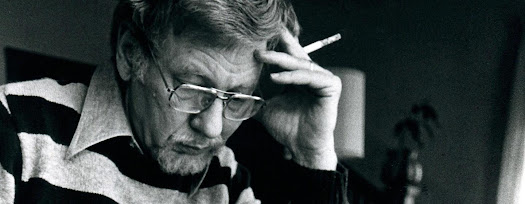
| The author of The Queen's Gambit considering his next move. |
Walter Tevis’ The Man Who Fell to Earth is about an alien who comes to Earth from the planet Anthea, which sounds a lot like Ray Bradbury’s Mars – an ancient, depleted world that is home to a dying race. The alien, who calls himself Thomas Newton, tells us there are only about 300 Antheans left and that the tiny spaceship he came in was 500 years old. Their world didn’t have enough fuel remaining to allow them to send more than one.
Review
Science fiction is never about the future; it’s about the
present in which it is written. It’s important to keep that in mind when
reading old science fiction stories. The Man Who Fell to Earth was written in
the early 60s, so its depictions of subsequent decades are merely projections
of the technologies and cultural trends of the 60s. And Tevis isn’t really
interested in trying to imagine the world of the 80s and 90s anyway. He is,
instead, far more interested in using his extraterrestrial character to explore
the feelings of alienation and existential despair shared by many in the
culture of his time.
While the Antheans are different in appearance from humans, they
aren’t so different that Thomas Newton can’t disguise himself to pass as human.
Eventually, he earns some money and hires an attorney to secure patents for his
“inventions.” In truth, Newton invents nothing; he simply adapts existing
Anthean technologies. These inventions make Newton rich, which in turn allows
him to establish a base of operations for his real goal.
I wasn’t a fan of the 1976 Nicholas Roeg film, in which
Newton’s goal is to transport water to Mars. His motivations in Tevis’ novel
are far more complex and interesting. This is a bit of a spoiler, so you may
want to skip the rest of this paragraph if that sort of thing bothers you. Newton’s
goal is to use Earth’s resources to build an interplanetary ferry that will
bring more Antheans to Earth. By disguising themselves, the Antheans will fit
into Earth societies, as Newton has done, so that they can eventually gain control
of terrestrial governments and militaries. Ultimately, they plan to do two
things: save us from ourselves and establish a new homeland (and a future) for
themselves.
Tevis wrestled with alcoholism, and so too does his alien.
Perhaps the genius of this novel is that it doesn’t depict the sort of
extraterrestrial invader that we’re used to, i.e., one that proceeds with
superhuman efficiency and determination. Rather, Newton is beset by emotional
as well as physical frailties. He suffers from self-doubt, he broods in
alcoholic despair, he makes mistakes. And, one more spoiler, he fails. Completely.
So, no, this isn’t a rollicking sci-fi adventure. It might be
more accurate to describe it as something more like a Raymond Carver story by
way of Kurt Vonnegut (but not as fun as the latter). Tevis didn’t describe any
future that came to pass, but his description of the heart in conflict with
itself remains pretty true.
Sunday, August 22, 2021
Thérèse Raquin by Émile Zola
I recently read Stephen King's new novel, Billy Summers, and was intrigued by the incidental fact that Billy was reading a novel by Émile Zola called Thérèse Raquin. King never describes the novel, but he mentions it several times, as if inviting you to take a look at it for yourself, So, I did.
Review
If you distilled Thérèse Raquin down to its essential plot points, you could almost turn it into an EC horror comic. Thérèse, through no agency of her own, is married to a sickly, boring young man named Camille. One day, Camille makes the mistake of introducing his wife to a robust, virile former schoolmate of his named Laurent, In time, Thérèse and Laurent become attracted to each other and begin to have an affair behind Camille's back. Eventually, they decide Camille is the one thing keeping them from complete happiness, so they plot his murder. The murder itself is played out in horrific, violent detail as Laurent drowns Camille in the Seine while Thérèse watches.
The lovers succeed in making the murder look like a boating accident, preempting any suspicions of foul play. Since it takes a while for the body to turn up because it had been pushed down into the current, Laurent takes to visiting the morgue each day, hoping to identify the body and help the police close the case. These visits, described in chapter thirteen, turn into a bit of Grand Guignol as Zola describes the corpses in vivid detail. We learn, along the way, that visiting the morgue is an entertainment for many.
Sometimes gangs of small boys came in, mere children of twelve to fifteen. who rushed along the windows and only stopped in front of female corpses. They leaned on the glass with their hands and ran their impudent eyes over the bare breasts, nudging each other and passing smutty remarks, learning vice in the school of death. Young louts have their first women in the Morgue.
With Camille finally buried and their crime unsuspected, the lovers decide to avoid each other's embraces for a while to further divert any thought that they might have had anything to do with it. They depend on mutual friends to ultimately suggest that perhaps the two of them should get together, which was also part of the plan all along. But each of them has become haunted by guilty visions of Camille's corpse. By the time they are joined in matrimony, each is repulsed by the other, and they are no longer able to experience the pleasure they felt when they were together illicitly. What follows is a gradual descent into hallucinatory madness, physical abuse, and vicious recriminations. The final paragraph of this nasty little novel is a masterpiece of degradation and spite that would, as I indicated earlier, have been at home in a pre-Code horror comic.
I have, of course, left out important developments and characters in this short summary, but it should be enough to let you decide if this is the sort of thing that interests you. I found the first half of the novel to be compelling reading, but it began to drag in the second half as the author prolonged the suffering of the two lovers. Nevertheless, I admired the unflinching way Zola examined the motives of his characters. In the beginning, when Thérèse falls for Laurent, Zola makes it clear that she does so for the physical pleasure of sex -- there's no mincing of words here. Even Laurent is a bit frightened at first by how much she enjoys it.
Reactions to this novel are fairly mixed. In its day is was famously described as "putrid" by one critic. While Zola held it up as a study in naturalism based on the interplay of character types, the novel is definitely overheated and "over the top" in all sorts of ways. Others have pointed out the similarities to Dostoevsky’s Crime and Punishment and Poe’s The Tell-Tale Heart. While I don't see any similarities to Billy Summers, I can certainly see why Uncle Stevie thought Thérèse Raquin worth bringing to his readers' awareness.
Saturday, July 10, 2021
Once Upon a Time in Hollywood: A Novel by Quentin Tarantino
| Same story, different take |
Review
Once Upon a Time in Hollywood is not, strictly speaking, a "novelization" of the film Once Upon a Time... in Hollywood.* The back cover of the book describes it as "The new novel based on the film," and that's an accurate description. Based on. The novel includes many scenes from the film, but it tells the story its own way -- leaving some things out, adding others, and indulging in digressions into Hollywood lore at even greater lengths. I'm going to assume that you've already seen the movie and won't worry about spoilers.
Like the movie, the novel follows events in the lives of TV actor Rick Dalton and his stuntman Clint Booth in the summer of 1969. The year is important because the entertainment business is changing. Rick has made a reasonably successful career of acting -- in manly, heroic roles -- in westerns and World War II movies. But, as the 70s approach, those kinds of movies and those kinds of roles are giving way to the influences of the counterculture. Bounty Law, the popular TV western in which Rick once starred, has been off the air for a few years, and he has been reduced to villainous guest-star roles on other TV shows. Thus, the novel opens with an agent encouraging Rick to takes roles in Italian "spaghetti" westerns to regain his status as a leading man. Again, as in the movie, Rick's worries over his fading status in Hollywood are an underlying current throughout the novel. Rick's interior monologue, as he ruminates on the recent past, gives Tarantino ample grist for digressions on movies, directors, and actors. While these digressions are interesting in themselves, they seriously impede the forward motion of the narrative, stalling it out at times to the point that you forget what's happening.
Rick's guest-star role on Lancer (a real-life TV show from the late 60s) is expanded upon in the novel to the point that it becomes a more-or-less fully fleshed western within the greater novel. No such episode ever existed, but it would have been a marvel if it had -- a Tarantino movie in the context of a 60s TV western! The real-life actor James Stacy, who played Johnny Madrid/Johnny Lancer on the show was portrayed by Timothy Oliphant in the movie and becomes a more fully developed character in the novel. (As an aside, I recommend the Wikipedia article on James Stacy if you'd like to learn more about his strange, tragic life and death.)
Besides the Lancer western, the other main story line in the novel -- as in the movie -- is that of Charles Manson, the Family, and the events that led toward the fatal night in August at the home of Roman Polansky and Sharon Tate. We also learn more about Cliff, his past as a war hero, and the fact that he's a three-time murderer. (Yes, he killed his wife; that was no boating accident.) Cliff's meeting with the Manson girls and his trip to the Spahn Movie Ranch play out fairly closely to the way they are depicted in the film. Perhaps the most surprising divergence from the movie is that the novel does not end with the hyper-violent, blood-soaked battle with the Manson Family in Rick's home that we saw at the end of the movie. Early in the novel we're told that it happened, and that it made Rick a cultural hero among right-wingers who hated "dirty hippies." Blink and you'll miss it, though, because the novel never circles back around to that melee.
The novel, instead, ends with Rick having a late-night conversation with his young co-star on the Lancer show, going over their lines, getting ready for their big scene together the next day. It's a much more reflective fade out that avoids the suspenseful buildup and final, explosive release that we have come to expect from Tarantino's films. (I'll also note, as another aside, that Tarantino inserts his own step-father into the story near the end and has him tell Rick that his son Quentin is a big fan.) I enjoyed reading this book, but I'm not entirely sure it works on its own as a novel. It really functions as a companion piece to the movie and as an amusing extra for die-hard Tarantino fans. If you fall into that camp, I recommend it. Otherwise, you'll probably want to pass.
-----
*Note that the posters for the movie read Once Upon a Time in... Hollywood, whereas all official copy related to the film reads Once Upon a Time... in Hollywood. Maybe it's because I'm a former editor, but this sort of inconsistency drives me nuts. The title of the novel foregoes the ellipsis altogether.
The Magic of My Youth by Arthur Calder-Marshall
![]() |
| Calder-Marshall hard at work on a novel |
Review
Mexican Gothic by Sylvia Moreno-Garcia
| Moreno-Garcia's master's thesis was on women and eugenics in Lovecraft's works |
As I was reading Mexican Gothic by Silvia Moreno-Garcia, the one thought that kept running through my mind was, "My, God! This woman writes beautifully!" She crafts her sentences with such limpid clarity that the book is a pleasure to read on that level alone. That's helpful because the story develops very slowly for fully two thirds of the novel's length, carefully putting each element in place, before the full horror is finally revealed. ReviewReviewers often mention Rebecca and Wuthering Heights when reaching for comparisons to Mexican Gothic, and they could also invoke My Cousin Rachel for the plot device that motivates our heroine Noemí Taboada to visit High Place. The real progenitors of this novel aren't so much gothic romances, though, as they are gothic horrors like Bram Stoker's Dracula and Matthew Lewis's The Monk, as well as weird tales like Charlotte Perkins Gilman's The Yellow Wallpaper and H.P. Lovecraft's The Colour Out of Space. For the record, Moreno-Garcia cites the stories of Horacio Quiroga and the horror films of Carlos Enrique Taboada as influences, though I confess to being unfamiliar with them.The evil patriarch of High Place is Howard Doyle, the name being a bit of a tribute to Howard Philips Lovecraft and Conan Doyle. Howard Doyle's "enormous jawline," of course, evokes Lovecraft's unusual appearance. Discredited theories of eugenics play an important role in this novel (a reference to Lovecraft's racist beliefs), as do the legacies of colonialism, racism, and misogyny in Mexico. But the real villain of this piece is Virgil, a Dracula-like seducer if there ever was one. The mounting disquiet that Virgil invokes draws you into the narrative as Noemí finds her mind gradually slipping. The eventual denouement does not disappoint. With suddenly escalating tension, disgusting rituals, and the revelation of a loathsome abomination in the catacombs below, this is gothic horror at its finest. |
Friday, July 9, 2021
The Forgotten Island: A Horror Novel by David Sodergren
![]() |
| David Sodergren loves his pug |
Short Review
David Sodergren's The Forgotten Island won't win any literary prizes for skillfully drawn characters or plausible sequences of events, but it is a fast-paced yarn that pulls you along with mounting suspense. And, best of all, it takes you to a "lost" tropical island that's infested with scary-ass monsters. If you like good, old-fashioned monster stories, this will scratch that itch. It's just begging to be turned into a low-budget, creature feature by a budding young Sam Raimi or George Romero wannabe. If I were Joe Bob Briggs, I would have tallied up the dead bodies and bare breasts for you. I didn't, but -- trust me -- there are plenty.
Tuesday, June 22, 2021
A Killing in Kiowa by Lewis B. Patten
| Patten was the author of more than a hundred western novels. |
Review
At times the story feels more like a crime noir novel than a traditional western. As soon as the sheriff has the boys in custody, the rancher and the banker (another of the boys' fathers) begin to bribe and intimidate witnesses. When it looks like that might fail, the rancher gathers his hands to help stage a jailbreak. The murder victim's brothers and friends, meanwhile, begin to threaten that justice will be done by any means necessary -- even if it results in "stringing up" the boys. Sheriff Wyatt has to try to keep a lid on the pressure cooker that the town becomes as the two sides get ready to go to war with each other.
The story is so tightly plotted that not a word is wasted. Every one of the sheriff's moves makes perfect sense, and even so the situation becomes more and more volatile, out of control, and potentially deadly. Adding to the complications for Sheriff Wyatt are the facts that one of the boys is the son of his deputy and the brother of his girlfriend. But he never wavers from trying to do his duty or to confront the violence that is relentlessly headed his way. The ending is fast and the resolution satisfying.
Wednesday, June 16, 2021
Riders of the Purple Sage by Zane Grey
![]() |
| Pearl Zane Grey gave up a promising career as a dentist |
Review
If you do any online searches to find out what are the best classic western novels, three books show up on pretty much every list: Walter Van Tilburg Clark's The Ox-Bow Incident, Owen Wister's The Virginian, and Zane Grey's Riders of the Purple Sage. Perhaps because Zane Grey's books were all over the paperback racks when I was a kid, I expected Riders of the Purple Sage to consist mostly of pulp-style action. I was surprised to discover that it's really pure melodrama. Western-style action does figure in the novel -- in the form of shootouts and horseback chases -- but the story leans far more heavily on romance, suppressed emotions, dark secrets, and long declarations of love complete with "palpitating" bosoms. The writing is old-fashioned and often repetitious. The long-delayed revelations (of which there are many) are, more often than not, painfully obvious. The intricate web of relationships borders on the absurd. And yet... and yet... I loved this book!
Early on, the main narrative bifurcates into two almost separate stories. In one, the Mormon woman who has inherited her father's ranch must, with the help of a mysterious lone gunman, defend it from ruthless men who will take it from her by any means necessary. In the other, a young man comes of age as he rescues a beautiful girl and builds a life with her in a hidden valley he discovers that's literally a lost world. (How many genre staples did you count in that description?) The villains of this work have the blackest hearts you've ever encountered, and the twist is that they are all high-ranking Elders of the Mormon church. Indeed, I had decided that Zane Grey must have hated Mormons, but a little research afterwards told me that his feelings were mixed.*
If you get past the archaisms and give yourself over to the story, you'll find yourself turning pages late into the night to find out what happens next, and what happens after that, and then what... Zane Grey doesn't stint on incidents right up to the very end. On top of that, his descriptive writing (especially in the hidden valley) can be first rate, and his insights into human nature are at times quite profound. There's a reason this particular title makes it onto all the classics lists.
------
* See Zane Grey in Zion: An Examination of His Supposed Anti-Mormonism by Gary Topping (https://scholarsarchive.byu.edu/cgi/viewcontent.cgi?article=1918&context=byusq)
Tuesday, June 8, 2021
The Cowboy and the Cossack by Clair Huffaker
Review
If the cattle drive in the far-better-known Lonesome Dove, from the Rio Grande to Montana, was long, the drive in Clair Huffaker's The Cowboy and the Cossack is far, far longer. The cowboys in this novel must cross an ocean with their beeves, to Vladivistok, Russia, and then push on deep into Siberia with them.
Once on Russian soil, however, the Slash-Diamond outfit is met by a Cossack named Captain Rostov who informs the cowboys that his own men will drive the cattle onward from that point. The outfit's leader, Shad, refuses, insisting that they will complete the job they were hired to do themselves. Thus begins a prickly alliance between the cowboys and Cossacks who will make the grueling trek together to a starved town called Bakaskaya.
Told entirely from the point of view of the youngest cowboy in the outfit, Levi (whose parents named him after the jeans), the novel is a traditional coming-of-age story. It's also an out-and-out men's adventure story. The only women in the tale are glimpsed while serving food and drinks in one of the rare towns but always remain remote, mysterious, and yearned for.
But as manly adventure yarns go, it's a corker. The men of two worlds, suspicious and hostile to each other at first, develop mutual respect and even friendship as they battle weather, imperial soldiers, wild animals, and even wilder men in the form of Genghis Kharlagawl and his Tartars. Adding to the complications, Shad and his men eventually learn that they were brought to Russia under false pretenses.
Much of the fun, of course, derives from our learning about the world of 19th century Russia through the young protagonist's eyes. This is not the Russia of War and Peace or Anna Karenina, though; it's the remote outposts of Eastern Russia and the no-man's land of the Mongolian border. I have no idea how much Russian history Huffaker may have studied to pull this off, but it comes across with complete believability. The writing is clear and compelling, pulling you through the 300 or so pages in a flurry.
Huffaker was a successful novelist, writing mostly Westerns in the 50s and 60s, and a sought-after screen writer with more than a dozen movies credited to him. Many of his Western novels were turned into movies, though, oddly, not the one that was undoubtedly his best.-
Gresham admiring the midway William Lindsay Gresham's first novel was his most famous. Nightmare Alley was published in 1946 and adapte...
-
Adrian loves insects and arachnids Children of Time is certainly a science fiction epic in the sense of being impressive in size and scope....
-
Novelist, screenwriter, and show runner Recursion is the second novel I've read by Blake Crouch. The first was Dark Matter (2016), a r...